Table of Contents
ToggleIf you’ve wandered the halls of Hogwarts Castle, you’ve probably noticed them, cats. Lots of cats. These furry little residents aren’t just window dressing: they’re collectible companions that add charm and personality to your playthrough. Whether you’re a completionist hunting for every last feline or simply curious about how to befriend these whiskered wanderers, understanding Hogwarts Legacy’s cat system opens up a rewarding layer of immersion that many players overlook. This guide covers everything you need to know about finding, bonding with, and appreciating every cat in the game.
Key Takeaways
- Hogwarts Legacy cats are collectible ambient NPCs scattered throughout the castle and Hogsmeade that reward thorough exploration and attention to detail without affecting character progression or combat.
- Collecting cats enhances immersion by transforming passive exploration into active engagement, encouraging players to discover hidden areas and creating memorable low-stakes interaction moments between major gameplay events.
- Hogwarts Legacy features dozens of visually distinct cats with unique coat colors and patterns, from common tabbies and blacks to rare variants like cinnamon and lilac, making each feline feel like an individual character.
- Cats found during exploration can appear in your dormitory as personalized decorations, creating tangible visual rewards that reinforce the sense of discovery and ownership over your magical home.
- Efficient cat hunting requires systematic exploration divided into manageable regions, attention to time-of-day variations, and checking three-dimensional spaces including rooftops and elevated alcoves that many players overlook.
- Visiting your dormitory between cat-hunting sessions creates natural break points in gameplay, allowing you to appreciate accumulated discoveries while maintaining engagement with the broader adventure.
What Are Cats in Hogwarts Legacy?
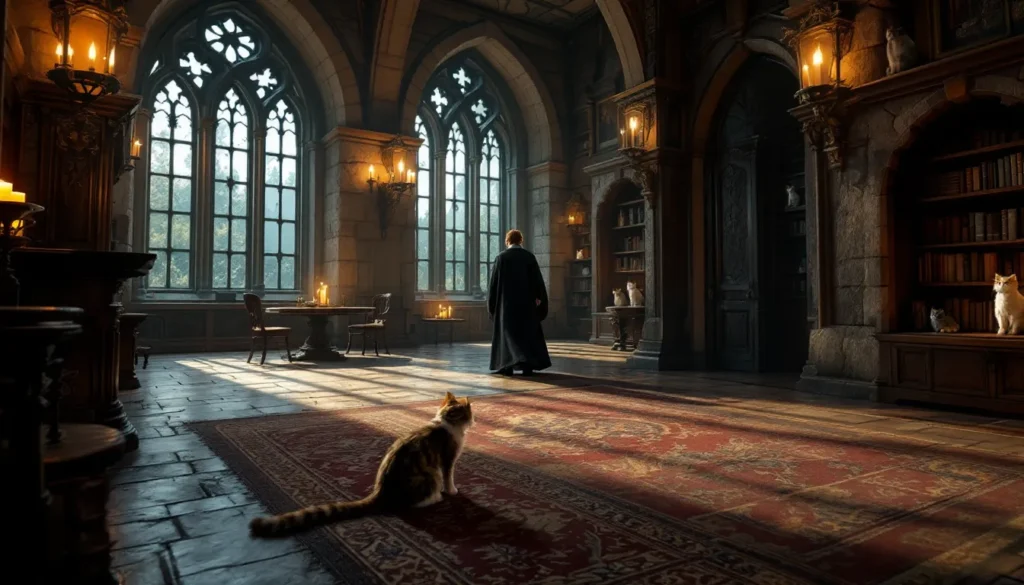
Cats in Hogwarts Legacy are ambient NPCs scattered throughout the game world. Unlike companion animals that follow you into combat, these are living, breathing parts of Hogwarts’ ecosystem, they lounge in common rooms, nap in hidden alcoves, and go about their daily routines regardless of your presence.
Each cat is a distinct character with its own appearance, personality quirks, and preferred locations. They’re not statistically relevant to your character’s power or progression, but they serve an important function: they reward exploration and attention to detail. When you encounter a cat, you can interact with it, and the game tracks your progress with each individual feline through the Hogwarts Legacy interface.
There are dozens of cats scattered across Hogwarts and Hogsmeade, each with unique coats, colors, and patterns. Some are easy to find in main thoroughfares: others hide in forgotten corners that only dedicated explorers will ever stumble upon. The cat system essentially gamifies something simple, petting a cat, into a satisfying collection mechanic that fits naturally into the fantasy adventure experience.
Why Collect Cats in Your Playthrough
How Cats Enhance Gameplay Experience
Collecting cats transforms passive exploration into active engagement. Every time you enter a new area, you’re not just moving from point A to point B, you’re scanning for familiar feline faces. This encourages thorough map exploration and rewards curiosity, which aligns perfectly with Hogwarts Legacy’s wider design philosophy of hiding secrets everywhere.
Cats also serve as satisfying validation moments. In a game filled with combat, puzzles, and story progression, the simple act of finding and petting a cat feels rewarding in its own way. It’s a low-stakes interaction that doesn’t require perfect execution or timed button presses, just discovery and connection. Gamers often find these moments more memorable than grinding through combat encounters, especially since they’re often tucked into atmospheric locations that justify lingering and absorbing the environment.
Beyond the mechanical reward, cats create natural break points in gameplay. Whether you’re taking a breather between boss fights or just wandering aimlessly after completing a questline, cats give you something to do. They anchor you to the world in a way that feels organic, not forced.
Aesthetic and Immersion Benefits
Hogwarts Legacy succeeds because it nails the fantasy. Cats are a huge part of making the castle feel lived-in and real. The developers didn’t need to include dozens of unique cats, a single generic cat model would’ve technically worked, but the decision to create variety elevates the entire experience. Walking through the library and seeing different cats in different positions creates a sense that this place exists independent of your presence.
Dormitory customization ties directly into cat collection. As you find cats and interact with them, your personal quarters become more personalized and cozy. Having your favorite feline lounging on your bed or perched on a shelf creates a sense of ownership and attachment that generic decoration options never quite achieve. It’s the difference between having a room and having a home.
The sheer variety of cat appearances, tabbies, blacks, orange, calicos, and rare color variants, gives collectors genuine incentive to seek them all out. Some cats are so visually distinct that spotting them becomes a mini-objective in itself, similar to the appeal of hunting for Hogwarts Legacy Field Guide Pages, another collectible that rewards thorough exploration.
Where to Find All Cats in Hogwarts Legacy
Castle Cats and Hogwarts Locations
The majority of Hogwarts Legacy’s cats are located within Hogwarts Castle itself. The library is a cat hotspot, multiple felines lounge among the bookshelves, and finding them all requires careful exploration of the upper and lower levels. Check behind pillars, under tables, and in quiet reading nooks.
The common room areas (Gryffindor, Slytherin, Hufflepuff, Ravenclaw) each host at least one cat. These are usually easier to spot since they’re in contained spaces, but arriving at off-peak hours increases your chances of finding them actually present and available for interaction. The Great Hall occasionally hosts cats, though their appearance times can be unpredictable.
Your dormitory is guaranteed to have cats if you’ve unlocked them through exploration. The Headmaster’s Office contains multiple cats in specific locations. Other notable castle locations include the Undercroft (a surprising amount of cats for such a hidden location), the Artifice Corridor, and various towers. The castle’s sheer size means most players will miss several cats on their first playthrough.
When searching the castle, remember that cats move between locations. Time of day matters, some cats are more active during evening hours, while others prefer daytime. If you’re not finding a cat you know exists in a particular area, try waiting or leaving and returning to the location.
Hidden Cats in Hogsmeade and Beyond
Hogsmeade is absolutely packed with cats, and this is where collectors will spend significant time. The village’s winding streets, multiple shop interiors, and hidden alleys contain dozens of felines. The Three Broomsticks has resident cats. Ollivander’s Wand Shop hosts at least one. Dervish and Banges, the post office, and various back alleys all have their own cats waiting to be discovered.
Cats in Hogsmeade are often more exposed than castle cats, making them easier to spot if you’re methodically working through the village. But, the sheer density means it’s easy to miss a few on your first visit. Return trips are essential. Pay special attention to rooftops, side streets, and building corners, Hogsmeade’s verticality means cats hide at multiple elevations.
Outside the immediate castle and village areas, cats appear in various Forbidden Forest locations, though they’re rarer here than in populated zones. The castle grounds occasionally host cats as well, typically near the greenhouses and main pathways.
Regional Cat Locations Across the Map
Hogwarts Legacy’s broader regions contain cats, though in lower concentrations than the castle and Hogsmeade. These regional cats are often tied to specific buildings or landmarks, making them easier to locate once you know where to look. The North Ford Bog has cats scattered near houses and outposts. Feldcroft Region contains several cats near populated areas. The Highlands, even though their vast size, host cats primarily in settlement areas rather than wilderness zones.
Cats in regional locations tend to be more accessible than castle cats, partly because there’s less ambient foot traffic and partly because they’re often in outdoor areas where they’re more visible. But, they’re also easier to overlook since you might pass through a region quickly while on a quest and never slow down to explore.
One efficient approach to regional cat hunting involves identifying all buildings and landmarks on your map, then checking each one methodically. Many players miss regional cats because they’re focused on main questlines and sidequests rather than environmental exploration. Dedicating a gaming session purely to cat hunting in one region ensures you won’t miss any. Unlike questing, which follows NPCs or objectives, cat hunting requires you to explore at your own pace, and that’s where the magic happens.
How to Bond With Cats and Build Relationships
Interaction Mechanics and Pet Features
Interacting with a cat is straightforward: approach one and a prompt appears allowing you to pet it. The interaction itself is simple, your character bends down, extends a hand, and the cat responds positively. Some cats purr: others lean into your hand: a few display more animated affection. These subtle behavioral differences make each cat feel distinct rather than a generic mesh clone.
Each cat you pet registers in your progression tracker. The game keeps count of how many cats you’ve encountered, though it doesn’t enforce any specific progression or level gates for interaction. Unlike traditional RPG relationships that level through dialogue and choices, cat bonding is purely about physical proximity and a single interaction. This simplicity is part of the design’s elegance, there’s no wrong way to bond with a cat.
The bonding system doesn’t have traditional “levels” in the sense that petting a cat multiple times doesn’t unlock new interactions. But, repeated visits to favorite cats create a sense of relationship. Some players report that cats recognize them by sitting closer or displaying more enthusiasm, though this is largely environmental flavor rather than a tracked mechanic. The real bond forms between you and your own experience of finding and befriending these creatures.
Unlocking Special Animations and Rewards
While Hogwarts Legacy doesn’t tie gameplay rewards directly to cat collection, it does offer subtle psychological rewards. Each new cat discovered triggers a moment of satisfaction, you found something hidden, and now you get to pet it. That loop, repeated dozens of times, creates genuine fulfillment that many players rank among the game’s most memorable moments.
Finding and bonding with cats that can appear in your dormitory provides tangible visual rewards. You’ll see these cats lounging on furniture, perched on shelves, or exploring your room. Unlike generic furniture or cosmetics, these represent cats you’ve personally discovered and brought into your personal space. The immersion factor multiplies because you know exactly where you found each one and remember the moment of discovery.
Some cats trigger unique animation variations, they’ll follow you briefly, rub against your legs, or react with heightened affection if you’ve visited them multiple times. These animations aren’t major gameplay events, but they reinforce the sense that your interactions matter. This ties into why collectors find cat hunting so compelling: there are tangible, visible outcomes to searching. Unlike abstract progression metrics, a cat sitting on your bed is concrete evidence that your exploration paid off.
The rewards system encourages revisiting favorite locations, which naturally leads to deeper familiarity with Hogwarts’ geography and hidden corners. You might return to find a specific cat, discover a new area in the process, and stumble upon entirely different secrets. This organic exploration cycle is exactly what Hogwarts Legacy’s design emphasizes across all its systems.
Unique Cat Breeds and Appearances in the Game
Distinctive Coloring and Fur Patterns
Hogwarts Legacy features a surprising range of cat coat variations. Tabby cats (featuring the classic striped pattern) are common throughout the castle and Hogsmeade. Black cats are well-represented, fitting the magical aesthetic perfectly. Orange/ginger cats appear regularly, as do calicos with their distinctive multi-color patches. Gray cats, white cats, and brown cats all appear in various locations.
Beyond basic colors, the game includes cats with distinctive markings. Some sport white chest patches, paws, or facial marks. Others have color combinations like orange and white, or black and gray. The visual variety means that even if you find 40 cats, each one feels somewhat unique at a glance. No two tabbies are identical: markings vary, stripe patterns differ, and individual cats have distinct personalities reflected in their idle animations.
The developers’ attention to detail in cat variety mirrors their approach to other environmental NPCs. Just as Hogsmeade residents have distinct appearances reflecting different house affiliations and roles, cats have visual distinction that makes each one feel like an individual rather than a reused asset. This variety justifies the time investment in collecting them all, you’re not just collecting the same cat repeatedly in different locations.
Rare and Hard-to-Find Cat Variants
Some cats are considerably rarer than others, either because they’re hidden in out-of-the-way locations or because they appear infrequently. The rarest cats typically feature unusual color combinations or distinctly different appearances compared to standard tabbies or solid-colored cats. These might include rare color patterns like cinnamon (a lighter brown variant), lilac (a grayish-brown), or unusual markings like specific facial patterns.
Finding rare cats requires patience and thorough exploration. Some cats only appear in locations most players skip unless specifically hunting for them. The castle’s highest towers, the Undercroft’s deepest chambers, and the most obscure Hogsmeade corners host the rarest variants. Experienced cat hunters learn to check these locations religiously, knowing that rare cats reward dedicated searching.
The rarity of certain cats creates natural difficulty progression for completionists. Early in the hunt, you’ll find cats easily, they’re obvious in common areas. As you progress, each remaining cat becomes harder to locate, requiring map knowledge and persistence. This graduated difficulty without explicit game signposting makes cat collection feel like an organic challenge rather than a forced achievement.
Comparable to searching for all hidden collectibles, cat hunting demonstrates how Hogwarts Legacy rewards thorough exploration. Unlike story-driven games that guide you to important locations, cat collection demands player agency. You choose when to hunt, where to search, and how exhaustively to explore each area. This autonomy, combined with the tangible reward of finding unique cat variants, explains why so many players rank cat collecting among their favorite Hogwarts Legacy activities.
Tips and Tricks for Cat Collectors
Efficient Routes for Finding All Cats
Systematic exploration beats random wandering every time. Start by dividing Hogwarts into regions, the library, classrooms, common rooms, dormitory areas, and so on. Tackle one region per gaming session, exploring every room, corner, and hidden alcove. This prevents redundant searching and ensures you don’t accidentally skip an entire area.
For Hogsmeade, work street-by-street. Start at one end of the village and methodically check every building interior, rooftop, and alley. Keep a mental (or actual) checklist of which locations you’ve thoroughly searched. Move to the next area only after you’re confident you haven’t missed anything.
Regional cats are easiest to find if you activate the location and scan the area using your focal vision. Cats will be highlighted as interactive elements, making them impossible to miss once you’re in the right location. This transforms regional cat hunting from exploration to targeted collection.
Use a guide selectively. If you find yourself in a cat-hunting rut after thoroughly exploring an area, consulting a detailed guide (like resources found on Shacknews) pinpoints specific locations you might’ve missed. But, discovering cats yourself before checking a guide preserves the satisfaction of the hunt. The ideal approach balances exploration with strategic guide usage.
Maximizing Time in Your Dormitory
Your dormitory becomes more rewarding as you collect cats. Once you’ve found several cats, visit your dormitory regularly to appreciate them. Seeing your collected cats lounging around creates a sense of achievement, they’re physical proof of your exploration efforts.
Decorate your dormitory intentionally around your favorite cats. If you’ve found an especially rare or visually striking cat, position furniture nearby so the cat is visible from your main seating area. This small customization reinforces your attachment to individual cats rather than treating them as generic collectibles.
Visiting your dormitory between quests provides a natural break point. Rather than immediately jumping to the next objective, spend a few minutes interacting with your cats, adjusting decorations, or simply appreciating the space you’ve created. These moments of calm recharge your engagement with the game’s story and combat systems.
The dormitory also serves as a natural stopping point for cat-hunting sessions. After an hour of methodical searching, return home, check on your cats, and let the accumulation of your efforts sink in. This psychological rhythm, search, return home, appreciate, keeps cat hunting from feeling like pure grinding.
Common Mistakes to Avoid When Cat Hunting
Don’t ignore time of day. Some cats only appear during specific hours. If you can’t find a cat that supposedly exists in a location, try returning at a different time. Waiting at a bench or sleeping in your dormitory shifts the in-game clock efficiently.
Avoid assuming cats are always in the exact same spot. While cats have preferred locations, they move around within those areas. A cat might be lounging on a chair one moment and exploring an adjacent room the next. If you’ve checked a location and found nothing, wait a few in-game hours and return. Movement patterns mean repeated visits to the same location can yield success when initial attempts fail.
Don’t overlook verticality. The castle and Hogsmeade are three-dimensional spaces. Cats lounge on upper levels, under stairs, on rooftops, and in elevated alcoves. Many players focus on ground-level exploration and miss entire groups of cats living literally above their heads. When searching a new area, deliberately check all vertical variations.
Avoid spreading yourself too thin. Hunting 50 cats across the entire game world without a system leads to confusion and missed targets. Organize your hunting into manageable chunks. Complete one defined area before moving to the next. This prevents the discouraging feeling of vaguely knowing there are more cats somewhere but having no clear direction.
Don’t skip the less popular areas. Most players thoroughly explore the library and main castle thoroughfares, but quieter locations like specific classroom wings or rarely-visited towers host cats that fewer players discover. These areas feel less populated partly because fewer players venture there, creating surprising cat density for those who do explore them.
Finally, remember that unlike game-breaking bugs or combat mechanics, cat-hunting mistakes aren’t catastrophic. If you miss a cat early on, you can always return later. If you collect cats out of order compared to some theoretical “optimal” path, it doesn’t matter. Cat hunting is flexible and forgiving, designed to be enjoyed at your pace.
Conclusion
Cats in Hogwarts Legacy represent more than just collectibles, they’re the game’s way of rewarding curiosity and validating exploration. Every hidden feline reinforces the message that Hogwarts is worth exploring thoroughly, that corners and crevices hold surprises, and that sometimes the best moments aren’t tied to quests or combat but to simple, genuine moments of connection.
Collecting cats transforms your relationship with Hogwarts itself. You’ll find yourself visiting areas repeatedly, not because you’re forced to by missions, but because you’re searching for something tangible. You’ll appreciate architecture and environmental design more deeply because you’re actively scanning spaces. You’ll remember specific locations not by their quest importance but by the distinct cats that live there.
The satisfaction of finding your final cat, of seeing your dormitory filled with collected companions, of knowing you’ve experienced everything this magical world has to offer, that’s where the real reward lies. Whether you’re a completionist bound to collect every last feline or a casual player who pets a few along the way, Hogwarts Legacy’s cats deliver moments of pure, unironic joy. In a game about magic, power, and adventure, sometimes the magic is just the simple pleasure of finding a hidden cat and making a friend. Start your hunt in the familiar library, work your way through Hogsmeade, and don’t stop exploring until every corner of this magical world becomes home. Your cats are waiting.