Table of Contents
ToggleStuck on a moth puzzle in Hogwarts Legacy? You’re not alone. These environmental puzzles pop up throughout the castle and its grounds, and they’re easy to miss if you don’t know what you’re looking for. Whether you’re hunting for collectibles, unlocking hidden areas, or just trying to figure out why that wall won’t budge, understanding how the moth puzzle mechanic works is essential. This guide walks you through every puzzle location, explains the mechanics, and breaks down the solutions so you can crack them efficiently and grab those sweet rewards.
Key Takeaways
- Hogwarts Legacy moth puzzles are light-based environmental challenges where you guide glowing moths to specific locations by casting spells on torches, candles, and magical light sources.
- The moth puzzle mechanic requires careful observation and a specific sequence of spell-casting actions to move moths from their starting positions to target formations, rewarding chests, collectibles, and quest progression.
- Before solving any moth puzzle, survey the entire area to identify all moth positions, light sources, and environmental clues—rushing into spell-casting without planning is the most common mistake.
- Moth puzzles appear throughout Hogwarts castle, the Undercroft, towers, dungeons, courtyards, and Hogsmeade, often guarding valuable loot including butterfly mirrors and contributing to your exploration completion percentage.
- If your initial spell doesn’t work on a light source, switch spells immediately rather than repeating the same action, as different puzzles may require fire, ice, or other spell types to trigger the correct response.
What Is the Moth Puzzle in Hogwarts Legacy?
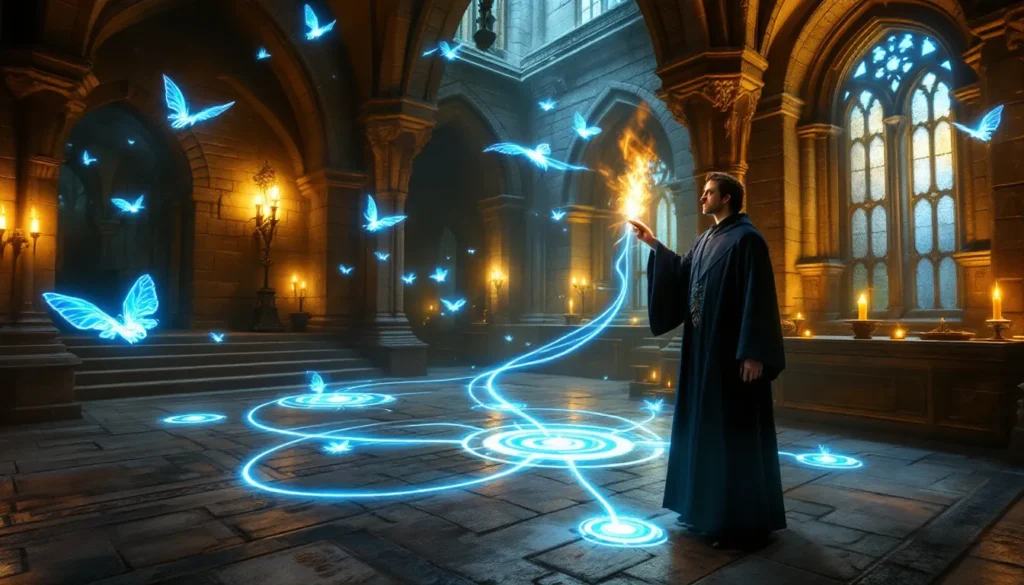
The moth puzzle is an environmental puzzle mechanic in Hogwarts Legacy that centers around animated moths that respond to light. Unlike more complex lock puzzles, moth puzzles are relatively straightforward but require you to understand their basic function. When you encounter one, you’ll see glowing moths scattered around a specific area, often near stone structures, doors, or magical mechanisms.
The core mechanic is simple: moths are attracted to light sources. By casting spells or interacting with light-emitting objects in the environment, you can guide the moths to specific locations. Once all moths reach their designated spots or a particular configuration is achieved, the puzzle completes and reveals a reward, usually a treasure chest, a hidden passage, or access to a collectible.
These puzzles aren’t combat challenges: they’re purely environmental brain-teasers. Your job is to figure out the correct sequence of actions or light sources to satisfy the puzzle’s requirements. The difficulty is low to moderate, making them accessible to players of all skill levels. They’re scattered throughout Hogwarts, the castle grounds, and surrounding areas, so you’ll encounter them naturally as you explore.
Moth Puzzle Locations in Hogwarts Legacy
Undercroft Moth Puzzle
The Undercroft moth puzzle is one of the most memorable moth puzzles you’ll encounter. Located in the lower chambers of Hogwarts, this puzzle guards a hidden treasure chest and requires careful attention to the moth positions. The Undercroft puzzle involves multiple moths positioned around a stone area, and you’ll need to light specific torches or magical structures in a particular order to guide them to their final resting places.
To locate it, head to the Undercroft area and look for the distinctive arrangement of stone pillars with unlit torches. The moths will be hovering nearby in a dormant state. This puzzle is often associated with finding valuable items and advancing certain questlines, making it a worthwhile stop during your exploration.
Other Notable Moth Puzzle Locations
Beyond the Undercroft, moth puzzles appear in several other locations throughout Hogwarts Legacy. You’ll find them scattered across the castle’s various towers, in the dungeons, and around the outdoor grounds. Some are tucked into side rooms off main corridors, while others sit in more open areas where you might stumble across them accidentally.
Common locations include:
- The Library and adjacent reading rooms – where natural light sources can be manipulated
- Courtyard areas – with torches and magical light fixtures
- Tower chambers – where candlesticks and enchanted lamps serve as light sources
- Hogsmeade locations – outside the castle proper, with environmental light puzzles
Each location’s puzzle is tailored to its surroundings, so the solution varies. Keep your eyes open for moths when exploring new areas, they’re usually positioned near walls or architectural features that give you a clue about what needs to happen next. You can also check your in-game map for any unexplored areas marked as puzzle zones.
How to Solve the Moth Puzzle: Step-by-Step Guide
Understanding the Puzzle Mechanics
Before jumping into solutions, it’s crucial to understand how the moth puzzle system actually works. Moths in Hogwarts Legacy are drawn to specific types of light, typically torches, candles, and magical light sources. When you interact with or cast spells on these light sources, the moths respond by moving toward or away from them.
Each puzzle has a specific end state: a configuration where all moths are positioned correctly. This might mean they’re all gathered in one location, positioned on individual platforms, or arranged in a specific pattern. Once they reach their final positions, the puzzle triggers automatically and unlocks its reward.
The key mechanic to master is spell casting on light sources. Different spells may have different effects, some spells ignite torches, others dim lights, and some manipulate magical fixtures entirely. Pay attention to what spells are hinted at in the environment. You might see scorch marks near certain torches (suggesting fire spells) or frost residue (suggesting ice-based interaction).
Solution Walkthrough
For the Undercroft moth puzzle, here’s the step-by-step solution:
-
Locate all moths – Survey the puzzle area carefully and identify each moth’s starting position. Take a moment to see where they are before taking any action.
-
Identify light sources – Look for torches, candles, magical braziers, or other light-emitting objects. Note which ones are already lit and which are dark.
-
Determine the target formation – Observe if there are visual cues indicating where moths should end up. Sometimes raised platforms, glowing marks, or architectural features hint at the goal positions.
-
Cast spells in order – Begin casting your light-based spells on torches or fixtures. Start with the torches furthest from where you want the moths to gather, then work inward. This guides them progressively toward their final destination.
-
Adjust as needed – If moths aren’t responding as expected, try casting on different light sources. The solution often involves a specific sequence rather than a single action.
-
Confirm completion – Once all moths settle into their final positions, the puzzle will typically show a visual confirmation (a glow, sound effect, or the appearance of a reward chest).
For other moth puzzles you encounter, the core approach remains the same: identify moths, locate light sources, figure out the target formation, and cast spells to guide them there. Some puzzles may require you to use Incendio (fire spell) to light torches, while others might need Diffindo or different spells depending on the puzzle design.
Common Mistakes to Avoid
Casting spells randomly – The worst approach is button-mashing spells and hoping something works. Take your time, observe the puzzle layout, and think through the solution logically.
Ignoring environmental clues – Hogwarts Legacy puzzles almost always have visual hints. Scorch marks, specific architectural arrangements, and torch placements all suggest which spells to use and the solution sequence.
Forgetting about spell requirements – Some puzzles require specific spells. If a torch isn’t responding to fire spells, try ice spells or other options. Pay attention to what the environment is telling you.
Missing moth positions – In dimly lit areas, it’s easy to miss moths that are partially hidden or outside your immediate line of sight. Always do a full survey before starting the puzzle.
Quitting too early – If a puzzle doesn’t solve on your first try, don’t assume it’s broken. Reread the setup, try a different sequence, and be patient. Many moth puzzles require you to light torches in a specific order.
Rewards and Benefits for Completing the Moth Puzzle
Completing moth puzzles in Hogwarts Legacy yields several valuable rewards that make the effort worthwhile. The primary reward is almost always a treasure chest containing gold, gear, or crafting materials. In some cases, completing a moth puzzle unlocks access to hidden areas that contain additional collectibles and loot.
Beyond immediate loot, solving these puzzles often contributes to completion percentage in specific areas. Hogwarts Legacy tracks exploration metrics, and puzzle completion plays into that. If you’re aiming for 100% exploration, moth puzzles are mandatory checkpoints.
Many moth puzzles also guard Butterfly Mirrors or related collectibles. If you’re hunting for every piece of gear or every puzzle-guarded item, these puzzles are essential stops. Some players specifically seek out butterfly mirror Hogwarts legacy locations, and many of these are protected by moth puzzles, meaning solving them is your gateway to those collectibles.
Another benefit is quest progression. Certain side quests and house-specific quests hinge on completing environmental puzzles. If you’re working through all the content, you’ll naturally encounter moths as part of quest objectives.
Finally, there’s the satisfaction factor, Hogwarts Legacy rewards exploration and puzzle-solving with an immersive sense of discovery. Each solved puzzle feels like you’ve uncovered a real secret in the castle, adding to the game’s appeal as an open-world experience.
Tips and Tricks for Solving Moth Puzzles Efficiently
Here are some practical strategies to speed up your moth puzzle-solving and avoid frustration:
Map out the puzzle before acting – Spend 30 seconds just looking. Identify every moth, every light source, and any obvious clues. A mental map beats trial-and-error every time. On higher difficulties, you might also notice that Hogwarts Legacy Headmaster’s Office: Uncover Secrets and Magic Within contains similar environmental puzzle design philosophy worth studying.
Use your camera to your advantage – Adjust your camera angle to see the entire puzzle area at once. Zoom out if possible. This gives you the full picture and helps you spot moths you might have missed.
Light torches progressively from back to front – Generally, it’s more effective to light torches furthest from the target area first, then work inward. This creates a visual “trail” the moths follow.
Watch for spell requirements – If your first spell doesn’t work, switch immediately. Don’t waste time casting the same spell repeatedly. Try ice, fire, and other damage spells to see what the puzzle responds to.
Stay patient with sequences – Some puzzles require a specific multi-step sequence. If nothing happens after the first action, keep going. Cast the next spell in the sequence and wait for the moth reaction.
Use fast-travel to reset – If you mess up a puzzle’s sequence and moths end up in the wrong spots, fast-travel away and return. The puzzle resets, letting you try again without reloading a save.
Check guides for visual confirmation – If you’re completely stuck, external resources like game guides on Twinfinite often have video walkthroughs showing the exact spell sequence. Seeing it in motion clarifies what you might be missing.
Collect all Field Guide pages while exploring – Hogwarts Legacy Field Guide Pages List: Discover Every Hidden Treasure often mentions puzzle locations and rewards, helping you prioritize which moths to hunt first. Cross-referencing your field guide with puzzle locations saves time.
Related Puzzles and Similar Challenges in Hogwarts Legacy
Moth puzzles aren’t the only environmental challenges you’ll face in Hogwarts Legacy. The game includes several related puzzle types that use similar mechanics or reward structures:
Statue and lock puzzles – Like moth puzzles, these require you to interact with environmental objects in a specific sequence. Hogwarts Legacy Statue with Ball puzzles, for instance, task you with moving stone balls onto pressure plates. The logic is similar: observe, plan, execute.
Torch and light-based puzzles – These share the light-source mechanic with moth puzzles but don’t involve moths. You’re simply lighting torches in a specific order to unlock doors or reveal secrets.
Gobstone challenges – While not exactly puzzles in the traditional sense, Hogwarts Legacy Gobstone Locations represent another form of interactive environmental content. They’re mini-games rather than puzzles, but they reward exploration similarly.
Astronomical telescope and celestial puzzles – Some areas of Hogwarts contain star-gazing and celestial alignment challenges that require observation and interaction with magical instruments.
Locked doors and mechanism puzzles – These range from simple (finding a key) to complex (multi-step interactions with magical devices). They often guard the same types of rewards as moth puzzles, treasure chests, collectibles, and quest progress.
Understanding that these puzzles follow similar logic frameworks helps you approach unfamiliar challenges with confidence. If you’ve cracked a few moth puzzles, you already know how to observe, hypothesize, and test your theory, skills that transfer directly to other Hogwarts Legacy environmental challenges.
The broader lesson from exploring Hogwarts Missions: Unlock Epic is that Hogwarts Legacy’s design philosophy encourages methodical exploration and logical thinking over combat skill. Every corner of the castle has something to discover, and puzzles are the gatekeepers to that content.
Conclusion
Moth puzzles in Hogwarts Legacy are straightforward but satisfying environmental challenges that reward careful observation and logical thinking. They’re scattered throughout the castle and its grounds, each one guarding valuable loot, collectibles like butterfly mirrors, and completion rewards. By understanding how moths respond to light, identifying the puzzle’s target configuration, and casting spells in the correct sequence, you’ll solve them consistently.
The key takeaway is patience and observation. Don’t rush into casting spells, take a moment to survey the puzzle, identify all the moths and light sources, and think through your approach. Whether you’re hunting for 100% exploration completion, chasing specific collectibles, or just want to experience everything Hogwarts Legacy has to offer, these puzzles are worth mastering. They’re easy enough to feel accessible but satisfying enough to make exploration genuinely rewarding.